What to Check When Buying a Used Lawn Mower
When buying a used lawn mower, check five things in this order: that the safety controls still stop the blade, that the engine starts cold and runs without smoke, that the deck is solid underneath, that the drive and belts work under load, and that the model has no open recall. A mower whose blade control or seat switch has been bypassed is not a bargain. It is a hazard, and you should walk away.
Most used-mower checklists start with the engine, because the engine is what sellers show you. This one starts with the safety system, because it is the part a seller is least likely to mention and the part that decides whether the machine can hurt you. Everything below is something you can check by looking, listening and watching the seller operate the machine. None of it requires you to put your hands near the blade.
Before you go: the model number does half the work
Ask the seller for the model and serial number, usually on a plate or sticker on the deck or frame, before you drive anywhere. With that you can do three things at home:
- Download the operator's manual from the manufacturer's site. It lists the safety-system checks for that exact model, which you will use at the sale.
- Search the CPSC recall database. The U.S. Consumer Product Safety Commission's Recalls and Product Safety Warnings page (read September 11, 2026) lets you search by product category and hazard. A recalled mower may still be repairable through the maker, but you want to know before you pay.
- Estimate the machine's age, which tells you whether a stack of wear parts is due. Our guide on what old lawn mowers are worth covers how age and condition affect value.
Ask the seller not to start the mower before you arrive. You want to see a cold start, and a warmed-up engine hides hard starting.
Check 1: the safety controls, first and non-negotiable
Walk-behind mowers: the blade control
Federal law sets a minimum here. Under 16 CFR 1205.5, the federal safety standard for walk-behind rotary power mowers (read September 11, 2026 via Cornell's Legal Information Institute), the blade control must prevent the blade from operating unless the operator actuates the control, must require continuous contact to keep the blade driven, and must bring the blade to a complete stop within 3.0 seconds after the control is released. A separate manual action is required before a stopped blade can be restarted.
At the sale, ask the seller to start the mower on a hard, flat surface, engage the blade, and release the control bar while you stand well back, out of line with the discharge opening. The engine may keep running on some designs; the blade should stop promptly and not restart until the control is deliberately re-engaged. You are listening for the blade winding down, not looking under the deck.
Riding mowers and zero-turns: operator presence and the other interlocks
CPSC's Riding Lawnmowers fact sheet, Publication 588 (read September 11, 2026), describes the operator presence control on machines built to the ANSI/OPEI B71.1-2003 standard: it stops the rotary blades if the operator leaves the control position without first disengaging the blade drive. Most riders also have interlocks tied to the brake and the blade engagement switch that affect whether the engine will start.
The operator's manual for the model lists its own safety-system checks. Ask the seller to perform them in front of you, from the operator's seat, while you watch from a safe distance. Do not climb on to test them yourself on an unfamiliar machine, and never stand near the deck while the blades are engaged.
Signs the safety system has been defeated
You are not looking for how it was done. You are looking for evidence that it was:
- A walk-behind control bar taped, tied or clamped to the handle.
- Wires near the seat, brake pedal or blade switch that are cut, spliced, taped together or disconnected.
- A seat switch, or its connector, that is missing or unplugged.
- A seller who says the mower "runs better" or "doesn't cut out" since a switch was removed.
- Safety labels missing or painted over. CPSC's service rules say to maintain or replace safety and instruction labels.
If any of these is present, walk away. CPSC's fact sheet is plain on this: never tamper with safety devices, and check their operation regularly. A machine that has been modified to keep the blade spinning without an operator in position is not repaired by lowering the price. Some sellers offer to "put it back." Restoring a safety system correctly is dealer or qualified small-engine technician work, and you have no way to verify it at the curb.
Check 2: the cold start and the engine
With the safety system confirmed, watch the engine.
- Starting. A healthy engine should start within a few pulls or a few seconds of cranking. Repeated pulls, heavy choking or a can of starter fluid on the bench are signs of fuel-system trouble. Our guide on why a mower won't start after winter storage explains what old fuel does to a carburetor.
- Smoke. A brief puff at startup can be normal on some engines. Continuous blue or white smoke suggests the engine is burning oil.
- Sound and idle. Listen for knocking, surging or hunting at idle.
- The oil. With the engine off, check the dipstick. Oil that is very dark, gritty, milky, or that smells strongly of gasoline points to neglect or internal trouble.
- The air filter. A filter caked with dirt, or dirt packed behind it, means dirt may have been pulled into the engine.
- The fuel. Ask what fuel has been used. Briggs & Stratton's fuel guidance (read September 11, 2026) says fuels with 15 to 85 percent ethanol are not approved for its small engines, and the EPA's E15 page (read September 11, 2026) states E15 cannot be used in nonroad equipment such as lawnmowers.
If the engine will not run at all, you are no longer buying a mower, you are buying a project. Price it that way or leave it.
Check 3: the deck, blades and spindles
Do this with the engine off, the key removed on a rider, and the spark plug wire disconnected, as the operator's manual directs before any work near the blade. CPSC's fact sheet says never make adjustments or repairs with the engine running, and to wrap the blade or wear gloves when servicing it. If the manual allows tipping a walk-behind to see under the deck, it also says which side goes up; follow it to keep fuel and oil where they belong.
Look for:
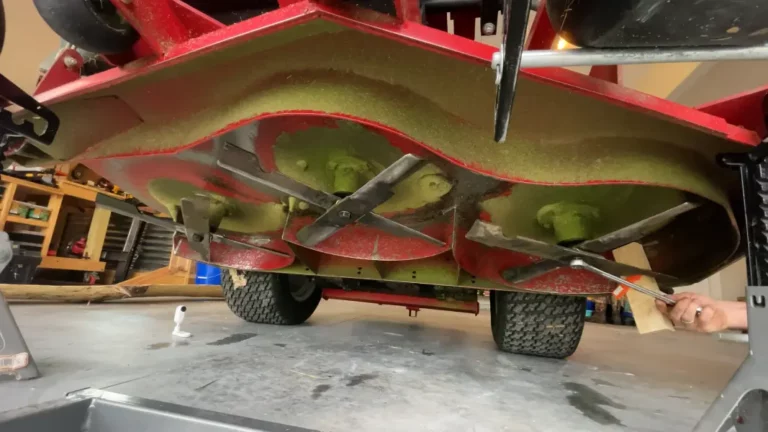
- Rust-through or cracks in the deck shell, especially where the blade housing meets the sides.
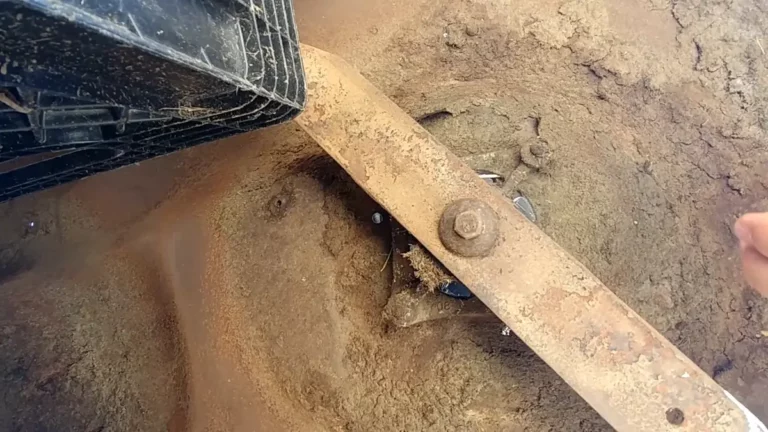
- A bent, chipped or badly worn blade. Our guide on signs your mower blade needs replacing shows what each looks like.
- Heavy caked grass, which suggests the underside was never cleaned and may hide corrosion.
- Wobble. On a running demonstration, a deck that shakes or vibrates hard when the blades engage can mean a bent blade or a worn spindle. Our piece on why a mower deck shakes when engaged lists the causes and which are expensive.
- The discharge guard, grass catcher or mulch plug. CPSC's fact sheet says not to operate a machine without the grass catcher, discharge guard or other safety devices in place and working. Missing guards are a cost to add to your offer, and a signal about how the machine was treated.
Check 4: drive, belts, tires and brakes
On a self-propelled walk-behind, have the seller engage the drive on a gentle grade. It should pull steadily without slipping or grinding.
On a rider or zero-turn, watch it move forward and back, and ask for a stop on level ground. It should hold without creeping when the brake is set. CPSC's service rules include checking brake operation frequently, so a brake that does not hold is a safety defect, not a cosmetic one.
With the engine off, look at the belts for cracks, glazing or fraying, and at the tires for dry rot, deep cracks and uneven wear. A wheel that wobbles on its axle points to worn bushings or bearings. None of these alone is a reason to walk away, but each is a cost to add to the price, and together they tell you whether the machine was maintained or merely stored.
Our checklist of signs a mower needs immediate attention covers other warning signs worth watching for during the demonstration.
Check 5: paperwork and the seller
- Proof it is theirs. A receipt, the original manual or a registration record all help. A seller who cannot explain where the mower came from is a reason to pause.
- Maintenance history. Oil changes, blade sharpening and filter changes, even as notes on a calendar, suggest care.
- Why they are selling. "Upgraded to a rider" is a better answer than a shrug.
- Warranty. Private sales rarely carry one. A dealer selling used equipment may offer a limited warranty; get what it covers in writing.
Keep the demonstration area clear
Every running check above happens with children and pets out of the area. CPSC's fact sheet says to make sure the area is clear of bystanders before operating and to stop the machine if anyone enters. That includes your own family if they came along to the sale.
What to check when buying a used lawn mower: the walk-away list
Walk away, or renegotiate hard, if you find:
| Finding | Why it matters |
|---|---|
| Any sign a safety control was bypassed | The machine is dangerous as sold and restoring it is technician work |
| Blade does not stop when the control is released | Fails the federal walk-behind blade-control standard |
| Brake will not hold a rider on level ground | A safety defect, not a wear item |
| Deck rusted through or cracked | Thrown debris and blade exposure risk; often not worth repairing |
| Continuous smoke or knocking | Internal engine damage likely |
| Open recall with no remedy completed | Contact the maker about the fix before paying |
FAQ
Is it safe to buy a used riding mower?
It can be, if the operator presence control and other interlocks work as the operator's manual describes and the brakes hold. Ask the seller to perform the manual's safety-system checks in front of you. Any sign the safety system was defeated is a reason to walk away.
How do I know if a used mower has been recalled?
Get the model and serial number from the seller and search CPSC's Recalls and Product Safety Warnings database. You can also contact the manufacturer with the serial number to ask about open recalls and whether the remedy was completed.
Should I buy a used mower that won't start?
Only as a repair project priced accordingly. A no-start may be a minor fuel-system problem or something far more expensive, and you cannot tell which at the sale.
What does a bypassed safety switch look like?
Common signs are a walk-behind control bar tied or taped to the handle, cut or spliced wires near the seat or brake, and a missing or unplugged seat switch. Treat any of them as a reason not to buy.
The short version
Check the safety controls before you check anything else, and let the seller do the operating while you stand clear. Then judge the engine cold, the deck from above with the plug wire off, and the drive under load. A good used mower is one where every safety system still does its job. A cheap one with a disabled switch costs far more than the price on the listing.