Signs Your Lawn Mower Needs Immediate Attention
TL;DR
- The clearest signs your lawn mower needs immediate attention are smoke from the engine, a hard or failed start, excessive vibration, and uneven or torn grass after cutting.
- Ignoring these symptoms can turn a $50 repair into a $175+ service call or a full engine replacement (Thumbtack, 2025).
- A hard start is almost always caused by a dirty carburetor, a fouled spark plug, or old fuel sitting in the tank since last season.
- Excessive vibration usually means a bent blade, a loose blade bolt, or debris jammed under the deck.
- Check these symptoms before the next mow – catching them early is the difference between a quick fix and a shop visit.
What “Immediate Attention” Actually Means for a Lawn Mower

credit: https://mowersboy.com/
Your lawn mower is telling you something is wrong through physical symptoms you can see, hear, and feel during every mow. Immediate attention means stopping before the next use and diagnosing the problem – not finishing the lawn first and hoping it clears up.
Some symptoms are minor maintenance triggers. Others mean the engine is at risk of serious damage if you keep running it. This guide covers both, starting with the most urgent.
White or Blue Smoke Coming From the Engine
White or blue smoke from a running lawn mower means the engine is burning oil. This is one of the most urgent signs on this list, and you should shut the mower off immediately when it happens.
The most common cause is a tilted mower – if you tipped the machine on its side to clear a clog and oil got into the cylinder, it will smoke off on the next start. That usually clears in a minute or two. If smoke continues past that point, you’re looking at a worn piston ring, a blown head gasket, or an overfilled crankcase. A head gasket repair on a riding mower can run $1,200 to $3,000 in labor and parts (Airtasker, 2025). Catching it at the oil-leak stage is far cheaper.
Black smoke is a different problem – it typically means the engine is running rich (too much fuel, not enough air), which points to a clogged air filter or a carburetor that needs cleaning.
The Mower Won’t Start or Takes Excessive Cranks
A healthy lawn mower with a tuned engine should start in one to three pulls or within a few seconds of electric start. If you’re pulling the cord five or more times, or the engine cranks and dies immediately, something needs attention before you mow another yard.
The most common causes, in order of likelihood:
- Old or stale fuel – gas stored without stabilizer breaks down in 30 to 60 days and gums up the carburetor (Briggs & Stratton, 2024)
- Fouled spark plug – a plug with carbon buildup won’t fire reliably; they cost $3 to $5 and take 10 minutes to replace
- Dirty carburetor – fuel residue clogs the jets and prevents proper fuel delivery; a shop charges around $50 for carburetor cleaning (Thumbtack, 2025)
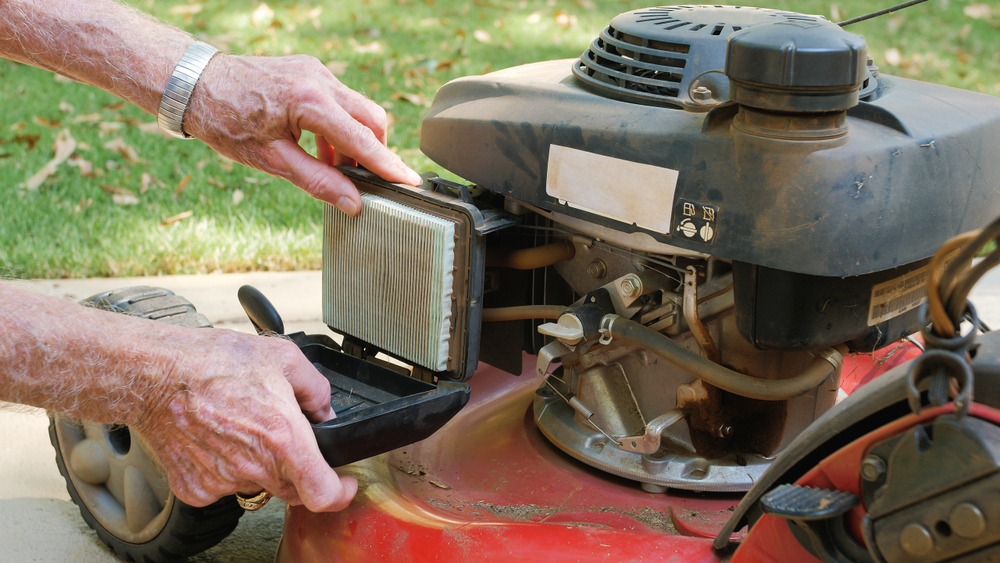
- Dirty air filter – a filter so clogged it restricts airflow enough to prevent starting; paper filters cost under $10
If your mower sat through the winter without a fuel stabilizer added, start there. Drain the old gas, refill with fresh 87-octane or ethanol-free fuel, and try again before touching anything else.
Excessive Vibration During Operation
Some vibration is normal in a single-cylinder gas engine. Vibration that is noticeably worse than usual, shakes your hands uncomfortably, or gets louder when you engage the blade is a warning you shouldn’t ignore.
The most likely causes:
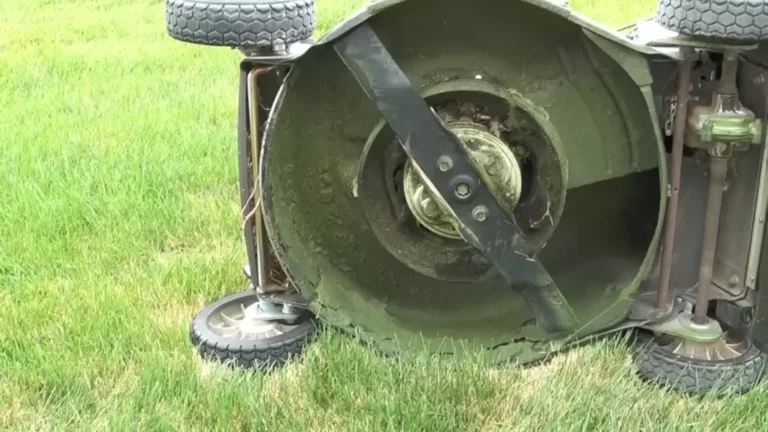
- Bent blade – even a minor bend from hitting a rock creates an imbalance that vibrates through the entire deck. A bent blade should be replaced, not straightened; a new blade runs $10 to $25 for most walk-behind mowers.
- Loose blade bolt – the bolt that holds the blade to the spindle can work loose over time. Check it with a torque wrench; most manufacturers spec 35 to 50 ft-lbs.
- Debris under the deck – a wrapped piece of wire, twine, or a stick jammed against a spindle will cause hard vibration. Always disconnect the spark plug wire before reaching under the deck.
- Bad spindle bearing – on riding mowers, a worn spindle bearing causes a grinding vibration and usually gets louder as the deck heats up. Spindle replacement at a shop typically runs $75 to $150 per spindle (LawnStarter, 2026).
If the vibration came on suddenly after hitting something in the yard, check the blade first. That’s the cause nine times out of ten.
Uneven Cut or Grass That Looks Torn Instead of Cut
Your lawn mower should leave a clean, level cut across the entire width of the deck. If you’re seeing strips of uncut grass, ragged brown tips a day after mowing, or a visibly uneven surface, the mower is telling you something is wrong.
A dull blade tears grass instead of cutting it. Torn grass turns brown at the tips within 24 to 48 hours and is more susceptible to disease and drought stress (Purdue University Extension, 2023). Blades should be sharpened every 20 to 25 hours of use – for most homeowners, that’s once or twice per season.
Other causes of an uneven cut:
- Deck is not level from side to side. Most walk-behind decks are adjustable at the wheel axles. Check the level with a tape measure: the blade tip should be 1/8 to 1/4 inch lower at the front than the rear (per most manufacturer specs).
- One wheel is at a different height than the others. This happens when a height adjuster gets knocked out of position.
- A bent or cracked deck shell warping the blade plane. Less common, but possible after a hard impact.
Oil Leak Under the Mower After Storage
A puddle of oil under a stored mower is worth investigating before starting the engine. Running a lawn mower low on oil is one of the fastest ways to destroy the engine. On most small engines, the oil and crankcase are sealed – any external leak means a failed gasket, a cracked case, or a loose drain plug.
Check the oil level with the dipstick before every start. Most 4-stroke walk-behind engines take 15 to 18 oz of SAE 30 oil in warm weather. Low oil won’t trigger a warning light on basic mowers – it will just seize the engine without warning. Engine replacement on a walk-behind mower runs $200 to $500 in parts and labor; on a riding mower, $400 to $900 or more (LawnStarter, 2026).
Warning Signs Summary: When to DIY vs. Call a Shop
| Symptom | Likely Cause | DIY Fix? | Estimated Shop Cost |
|---|---|---|---|
| White or blue smoke | Burning oil (rings, gasket, overfill) | Only if overfilled | $150 to $3,000 |
| Black smoke | Rich fuel mixture, clogged air filter | Yes – replace air filter | $40 to $80 |
| Won’t start | Stale fuel, spark plug, carburetor | Usually yes | $50 to $130 |
| Excessive vibration | Bent blade, loose bolt, spindle | Blade: yes; Spindle: shop | $30 to $150 |
| Uneven cut | Dull blade, unlevel deck | Yes | $20 to $60 |
| Oil leak | Failed gasket, loose drain plug | Sometimes | $60 to $300 |
Cost data: Thumbtack, 2025; LawnStarter, 2026; Airtasker, 2025.
Mistakes That Turn Small Problems Into Big Repair Bills
- Continuing to mow when the engine is smoking: running a smoking engine drives the damage deeper, often turning a gasket issue into a full rebuild.
- Using last season’s untreated fuel: Briggs & Stratton recommends using fuel within 30 days or adding a fuel stabilizer like STA-BIL before any storage period (Briggs & Stratton, 2024). Stale gas is the number one reason mowers won’t start after winter.
- Skipping the oil check before each mow: most walk-behind mowers have no low-oil shutoff. Letting the oil drop below the minimum mark on the dipstick risks seizing the engine entirely.
- Sharpening a bent blade instead of replacing it: a bent blade that gets sharpened and reinstalled still vibrates, still damages spindle bearings, and still tears grass. Replace bent blades outright.
Frequently Asked Questions
What are the most common signs a lawn mower needs repair?
The most common signs are difficulty starting, white or blue smoke from the engine, excessive vibration during operation, and an uneven or ragged cut. Any of these that appears suddenly – especially after the mower sat through winter – warrants a check before the next use.
Can I keep mowing if my lawn mower is vibrating a lot?
No. Excessive vibration is usually caused by a bent blade or a loose blade bolt, and continuing to run the mower risks damaging the spindle bearings and the engine mounts. Shut it off, disconnect the spark plug wire, and inspect the blade and blade bolt before mowing again.
Why does my lawn mower smoke when I first start it?
If the smoke is white or blue and clears within about a minute, oil likely got into the cylinder when you tipped the mower on its side to clear a clog. That’s normal and burns off quickly. If smoke continues past two minutes or appears mid-mow, shut the mower off and check for oil overfill, a blown head gasket, or worn piston rings.
How much does it cost to repair a lawn mower?
Most lawn mower repairs cost $75 to $550 including parts, with labor running $55 to $135 per hour (LawnStarter, 2026). Thumbtack data puts the national average at $173, with common single-item repairs like carburetor cleaning running around $50 (Thumbtack, 2025). Head gasket work is the most expensive, ranging from $1,200 to $3,000 on larger engines (Airtasker, 2025).
How do I know if I should repair or replace my lawn mower?
A common rule of thumb from small engine repair shops: if the repair cost exceeds 50% of the mower’s current replacement value, consider replacing it. A $150 carburetor job on a $600 mower is worth doing. A $400 engine rebuild on a $350 mower is not.
How often should spark plugs be replaced in a lawn mower?
Briggs & Stratton recommends replacing the spark plug every season or every 100 hours of operation, whichever comes first (Briggs & Stratton, 2024). A fresh plug on a mower that’s hard to start is one of the cheapest and fastest fixes you can make – plugs run $3 to $8 at any hardware store.
Quick Checklist Before Your Next Mow
- Check oil level on the dipstick before starting the engine
- Inspect under the deck for wrapped debris or a visibly bent blade
- Listen for any vibration or rattling that wasn’t there last time
- Note whether starting required more pulls than usual
- Look for any oil spots on the ground where the mower was stored