Why Grass Dies in Circular Patches: Causes and Fixes
TL;DR
- Grass dies in circular patches from one of five causes: fungal disease, white grubs, dog urine, fairy ring, or a spilled chemical like fertilizer or gas.
- The fastest diagnostic test is the tug test. If a brown patch lifts like loose carpet with no roots, you have grubs (University of Minnesota Extension, 2023).
- Dog urine spots show a dead brown center with a dark green outer ring; fungal patches usually do not.
- White grubs need treatment once you count 5 to 10 per square foot under the damaged edge (Penn State Extension, 2024).
- Match the pattern to the cause before you spend money. Treating fungus when you have grubs wastes both time and product.
What Causes Grass to Die in Circular Patches?
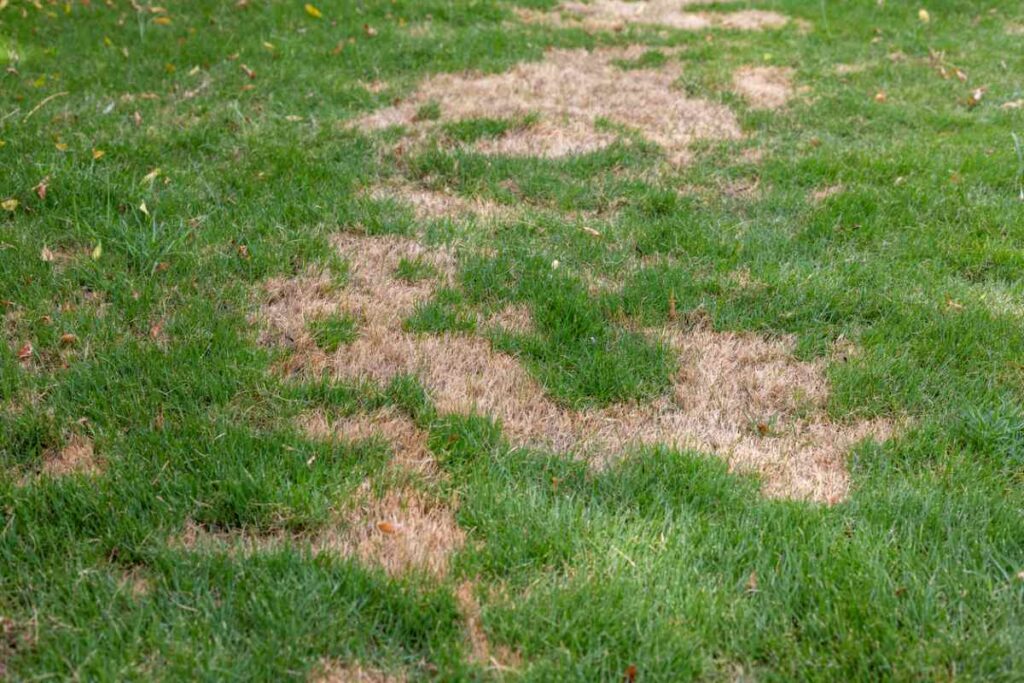
Grass dies in circular or ring-shaped patches because the damaging agent spreads outward from a single point, and most lawn problems do exactly that. Fungi grow radially through the soil, grubs hatch and feed in clusters, and a dog returns to the same spot to urinate. The shape itself is your first clue.
Five causes account for nearly every circular dead patch in a US home lawn:
- Fungal disease, including dollar spot and brown patch, which spread in expanding circles.
- White grubs, the larvae of beetles, which chew grass roots from below.
- Dog urine, which burns a round spot and leaves a tell-tale green ring.
- Fairy ring, a soil fungus that forms rings of dead, dark green, or mushroom-covered grass.
- Chemical spills, such as concentrated fertilizer, gasoline, or herbicide dropped in one area.
The rest of this guide walks through how to identify each one and what to do about it.
How Do You Tell What Is Killing Your Grass?
Start with the tug test, then check the center-and-edge pattern of the patch. Grab a handful of grass at the edge of a brown patch and pull. If the turf peels back like loose carpet with no roots holding it down, grubs have eaten the root system (University of Minnesota Extension, 2023). If the grass holds firm, the cause is above ground: disease, urine, or a spill.
Next, look at the shape and coloring. A dead center with a bright green outer ring points to dog urine. A circle of dark green grass or mushrooms points to fairy ring. Silver-dollar-sized tan spots that merge together point to dollar spot fungus.
| Cause | Patch appearance | Tug test result | Best clue |
|---|---|---|---|
| White grubs | Irregular brown patches, late summer | Lifts like carpet, no roots | Skunks or raccoons digging at night |
| Dog urine | Dead brown center, dark green ring | Holds firm | Green ring; dog uses the spot |
| Dollar spot | Tan circles up to 6 inches, may merge | Holds firm | White cobweb threads at dawn |
| Brown patch | Light brown circles, inches to feet wide | Holds firm | Smoky gray ring at the edge in morning |
| Fairy ring | Ring of dark green, dead, or mushrooms | Holds firm | Perfect circle that grows yearly |
When Is It a Fungal Disease Like Dollar Spot or Brown Patch?
Suspect fungal disease when the grass holds firm to the soil and you see circular tan or brown spots that appeared during warm, humid weather. Two fungal diseases cause most circular patches in home lawns.
Dollar spot shows up as small, sunken, circular spots the size of a silver dollar, straw to tan in color, that can expand to several inches and merge into larger irregular areas (University of Maryland Extension, 2025). A reliable sign is white, cobweb-like fungal threads on the grass early in the morning when dew is present. Dollar spot favors temperatures between 60 and 80 degrees Fahrenheit and often appears first in spring.
Brown patch is the bigger cousin. On taller home-lawn turf it appears as light brown circular patches that range from a few inches up to several feet across. Look for a smoky brown or gray ring at the active edge during early morning dew. Brown patch favors hot, humid nights between 70 and 90 degrees Fahrenheit, and lawns pushed with too much nitrogen are more prone to it.
For both, the fix starts with culture, not chemicals. Water early in the day so blades dry by evening, mow at the recommended height for your grass, and avoid heavy nitrogen during disease-favorable weather. Most home lawns recover without fungicide once conditions change.
When Are White Grubs the Cause?
White grubs are the cause when brown patches appear in late summer and the turf lifts away from the soil like a loose carpet. Grubs are the larvae of beetles such as Japanese beetles and masked chafers, and they feed on grass roots a few inches below the surface.
Confirm them by counting. Cut a one-foot square of sod on three sides, peel it back, and sift the top two to three inches of soil. The white, C-shaped larvae are easy to spot. Sample at the edge of the damage, not the dead center, because grubs move out of fully killed areas.
The treatment threshold for most home lawns is 5 to 10 grubs per square foot, though a healthy, well-watered lawn can tolerate more before it shows damage (Penn State Extension, 2024). A separate warning sign is skunks, raccoons, or crows tearing up the turf at night to eat the grubs, which can happen even at lower grub counts. Curative insecticides work best on small, actively feeding grubs from August through October.
When Is It Dog Urine, Fairy Ring, or a Spill?
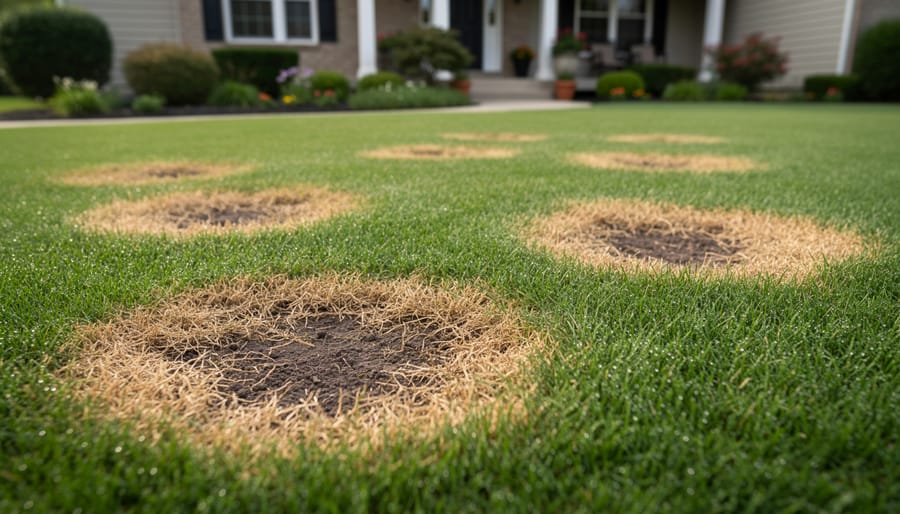
Dog urine, fairy ring, and chemical spills each leave a signature pattern that separates them from disease and grubs. Match the look of your patch to the descriptions below.
Dog urine creates a round dead spot, brown or yellow in the center, surrounded by a ring of darker, faster-growing green grass. The concentrated nitrogen and salts in the center burn the grass, while the diluted edge gets just enough nitrogen to act as fertilizer. Female dogs and larger breeds tend to leave bigger spots because they release more in one place. Flush fresh spots with water, and reseed dead centers once you rake them out.
Fairy ring is a soil fungus that breaks down buried organic matter such as old roots or thatch. It shows up three ways: a ring of lush dark green grass, a ring of dead brown grass, or a circle of mushrooms after rain (NC State Extension, n.d.). The dead-ring type happens when the fungus makes the soil water-repellent, starving the roots beneath. Rings start small and grow wider each year. Fungicides rarely help; aeration, deep watering, and thatch reduction manage it best.
Chemical spills leave a sharply defined dead patch with no green ring and no fungal threads, usually where someone spilled concentrated fertilizer, gasoline, or herbicide. The edges are often crisp rather than gradual. Flush the area with heavy water to dilute salts, then reseed once the soil drains.
Common Mistakes That Cost You More in the Long Run
- Treating for fungus when you actually have grubs. The two need completely different products, and a misdiagnosis wastes a full season. Run the tug test first.
- Spraying fungicide on fairy ring. Fungicides rarely control fairy ring, so the money is wasted. Aeration and watering work better.
- Treating grubs without counting them. Below 5 per square foot, a healthy lawn usually does not need insecticide. Count before you spray.
- Assuming a brown patch is always dead. Yellow or lightly browned grass often still has live roots and can recover with water and time.
- Watering at night during humid weather. Wet blades overnight feed dollar spot and brown patch. Water in early morning instead.
Frequently Asked Questions
Why does my grass die in a perfect circle?
A near-perfect circle usually means fairy ring or a fungal disease, both of which spread outward from a center point. Fairy ring forms a ring of dark green, dead, or mushroom-covered grass that grows wider each year (NC State Extension, n.d.). Fungal diseases like dollar spot start as round spots that can merge.
How do I know if it is grubs or fungus?
Use the tug test. Grab the grass at the edge of a brown patch and pull. Grub damage lifts like loose carpet because the roots are eaten through, while fungal damage and drought hold firm to the soil (University of Minnesota Extension, 2023). You can also dig a square of sod and count white C-shaped grubs underneath.
Can grass grow back after it dies in patches?
It depends on the cause and severity. If the roots and crowns are still alive, watering and good care often bring the grass back. Fully dead centers, such as a burned dog-urine spot or a heavy grub kill, will not regrow on their own and need raking and reseeding.
What time of year do circular dead patches appear?
Dollar spot often shows first in spring at 60 to 80 degrees Fahrenheit, brown patch peaks in hot humid summer nights, and grub damage usually shows from late August into October. Fairy ring can appear in spring, summer, or fall.
Should I call a professional or fix it myself?
You can diagnose and fix most circular patches yourself once you identify the cause. Reseeding dog spots, aerating fairy ring, and improving watering are all DIY jobs. Call a pro if grub counts are high and you want a labeled curative insecticide applied correctly, or if a disease keeps returning every year.
How can I prevent circular dead patches in the first place?
Water deeply in early morning, mow at the right height for your grass, manage thatch, and avoid dumping excess nitrogen in one area. A healthy, well-rooted lawn tolerates grubs, disease, and dog spots far better than a stressed one.