Best Mower for a Sloped Yard: Traction, Weight & Safety
For a sloped or hilly yard, the best mower is usually a self-propelled walk-behind with rear-wheel or all-wheel drive, large traction wheels, and a low, stable stance. On a slope, traction, weight, and drive type matter far more than horsepower or deck size. Just as important, the technique and the slope limit matter more than the machine itself. Most riding mowers and zero-turns are rated for no more than about 15 degrees of slope, so before you shop, measure your hill. Some slopes should not be mowed with a standard mower at all, and knowing that line is the most useful thing on this page.
That is the short version. The rest of this guide explains how to judge your own slope, what to look for in a mower, what goes wrong when you get it wrong, and the safety rules that keep the whole thing from ending badly.
How steep is too steep? Measure your slope first
Before comparing mowers, put a number on your hill. "Steep" is a feeling; degrees are a fact, and every mower manual sets its limit in degrees or in "rise over run."
The simplest home method: lay a straight board on the slope, level it with a phone level app, and measure how far the low end sits off the ground. A board 24 inches long held level with its low end 6 inches up gives you a slope of roughly 14 degrees. If you would rather not do math on a hill, a builder's angle app on your phone laid on the ground gets you close enough to compare against a manual.
Here is the range that matters for buying:
- Under about 10 degrees: gentle. Most self-propelled walk-behinds handle this comfortably, and many riding mowers do too.
- Roughly 10 to 15 degrees: moderate to steep. This is walk-behind territory, ideally rear-wheel or all-wheel drive. Riding mowers get risky near the top of this band.
- Above about 15 degrees: many manufacturers rate their riding mowers and zero-turns at no more than about 15 degrees, so past this point you are usually out of ride-on territory entirely, and even some walk-behind mowing becomes a judgment call.
- Very steep banks and ditches: not standard-mower work at all. See the section on when a slope is too steep for any mower.
Treat those numbers as the general pattern in the market, not a promise about your specific machine. The only rating that governs your mower is the one printed in its own operator's manual, and you should read it before you mow anything that makes you nervous.
What actually matters on a slope
Marketing copy leads with engine size. On flat grass that is fine. On a slope, the machine's ability to grip, stay planted, and pull itself uphill is what keeps you safe and gets the grass cut evenly. Judge candidates in this order.
Drive type: rear-wheel and all-wheel drive beat front-wheel drive
This is the single biggest factor in a self-propelled mower. Front-wheel-drive mowers lose traction going uphill because your push shifts weight to the back, lifting the powered front wheels, and they spin. Rear-wheel drive keeps the pull where the weight is. All-wheel drive powers every wheel, which is why it grips best on uneven, sloped ground where any single wheel can lift off the surface.
If your yard is mostly slope, prioritize all-wheel drive; if it is rolling with some flat, rear-wheel drive is usually enough. A push mower with no drive assist is the hardest and least safe option on a real hill, because you are supplying all the uphill force yourself. For a fuller breakdown of when the drive assist is worth it, see our guide on self-propelled versus push mowers.
Weight and center of gravity
A lighter mower with a low profile is easier to control and less likely to tip or slide than a tall, heavy one. Weight helps traction on flat ground, but on a slope a high center of gravity is what starts a rollover. This is exactly why a compact walk-behind is safer on a steep bank than a tall riding mower: the walk-behind sits low and you stay off it, so your weight is not part of the equation up top.
Wheel size and traction
Larger rear wheels, often 10 inches or more, roll over bumps and hold a line on a slope better than small wheels that dig in and slip. Deep, aggressive tread matters more than tire count. Wheel size will not rescue the wrong drive type, but paired with rear or all-wheel drive it noticeably improves grip on uneven ground.
Deck size, matched to the slope
Bigger is not better here. A wide deck is harder to keep flat against a changing slope, which leads to scalping on the high side and missed grass in the dips. On uneven ground a narrower deck follows the contour more closely. Match the deck to your yard rather than buying the widest one you can, and if you are unsure how deck and mower size relate to your lawn overall, our overview of how to choose the right lawn mower size walks through it.
What goes wrong when the wrong mower meets a slope
Most buying guides stop at the feature list. The more useful question is what actually fails when you put the wrong machine on a hill, because those failures are how you end up shopping in the first place.
- Steering and traction loss. On a riding mower, going across a slope unloads the uphill wheels. The mower can slide sideways, and the steering goes light or unresponsive because the front wheels are barely touching down. That is not a broken steering system, it is physics telling you the mower is past its limit.
- Hydrostatic drive straining. Hydrostatic transmissions on riding mowers and zero-turns work hard under the uneven load of a slope, especially in heat, and can feel weak, surge, or lose drive on an incline that a flat yard never revealed. A slope exposes a marginal drive system fast.
- Uneven, scalped cuts. A deck that cannot stay level with the ground scalps the high spots and skips the low ones, so the lawn looks worse after mowing, not better. On a slope this is usually a deck-and-terrain mismatch, not a blade problem.
- Wear that shortens the machine's life. Belts, spindles, and drive components all take extra load on slopes, so a mower worked past its comfortable grade wears out sooner. That is worth weighing against price, and our look at which lawn mowers actually last covers the durability side of this decision.
If you already own a mower that does any of the above only on the hill, the honest read is usually that the mower is at or past its rated slope, not that it is defective. The fix is a different machine or a different technique, not a repair.
The case against riding mowers and zero-turns on steep slopes
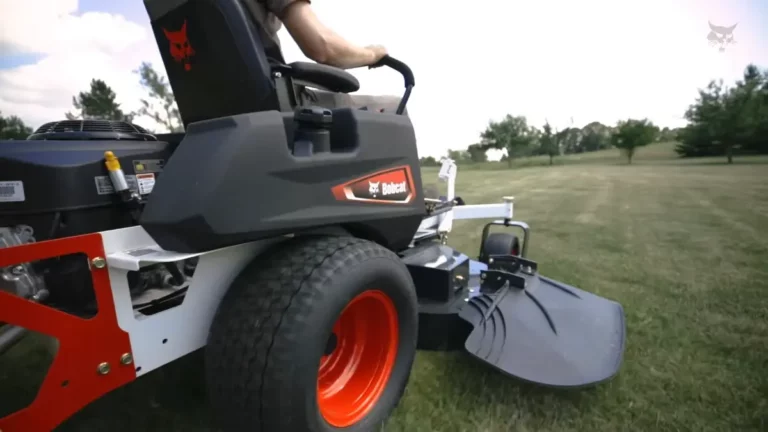
Riding mowers and zero-turns are wonderful on big, mostly flat or gently rolling lawns. On steep ground they are the most dangerous option, because loss of control and tip-over are the leading serious-injury patterns with ride-on equipment, and your body is on top of a heavy machine when it happens. Zero-turns add a specific weakness: their rear-wheel steering can lose grip and slide on a slope, and the caster front wheels give little help holding a line.
The practical rule: if your slope is near or above roughly 15 degrees, do not solve it by buying a bigger ride-on. Solve it with a walk-behind, or with one of the alternatives below. A riding mower earns its place on the flatter parts of a mixed property, not on the bank. If most of your yard is flat with only a hilly strip, our guide on when to upgrade to a riding mower helps you weigh that split honestly.
Walk-behind or ride-on, side by side
The two machine types on the dimensions a slope actually tests.
| On a slope | Self-propelled walk-behind, rear or all-wheel drive | Riding mower or zero-turn |
|---|---|---|
| Where your weight is | Off the machine. It sits low and you stay behind it | On top of a heavy machine |
| Direction you mow | Across the slope, never up and down | Straight up and down, never across |
| How control is lost | A front-wheel-drive unit spins its powered wheels uphill, and mowing up and down risks the mower rolling back onto you | The uphill wheels unload, the mower can slide sideways, and the steering goes light because the front wheels are barely touching down |
| Drive weakness a hill exposes | Front-wheel drive, which loses traction because your push shifts weight to the back and lifts the powered wheels | Hydrostatic drive, which can feel weak, surge or lose drive under the uneven load of a slope, especially in heat |
| Traction that helps | Rear-wheel drive, or all-wheel drive where any single wheel can lift off the surface, with large, deeply treaded rear wheels | Zero-turn rear-wheel steering can lose grip and slide, and the caster front wheels give little help holding a line |
| Where the limit is set | The operator's manual, in degrees. Walk-behind ratings vary by model | The operator's manual, in degrees. Past that rating you are out of ride-on territory entirely |
| Best suited to | The slope itself, and the hilly strip of a mixed property | Large, mostly flat or gently rolling lawns, and the flatter parts of a mixed property |
The direction row is the one that gets people hurt, because the two rules are opposites and the habit from one machine is wrong on the other. What this table does not decide is whether your slope should be mowed at all. Measure it and check it against your own machine's rated maximum in its own manual first, and the section below covers the ground that is not standard-mower work for either column.
When a slope is too steep for any mower
Some ground should never see a wheeled mower, ride-on or walk-behind. On very steep banks, drainage ditches, and pond or retaining-wall edges, a slip means the machine slides and you go with it. The safer tools for that ground are:
- A string trimmer or brush cutter, used while you stand on stable ground above or beside the slope. This is the standard answer for steep banks and is far safer than forcing a mower onto them.
- A robotic mower, for slopes within a given model's rated grade. Some robotic and all-wheel-drive robotic models are built specifically for inclines and remove you from the hill entirely, though you must still keep pets and children clear and check the model's slope rating.
- A manual reel mower, for a small, gentle slope where you want no engine and full control, though a reel mower is not the tool for a genuinely steep bank.
- Ground cover or landscaping, the long-term fix. Planting a low-maintenance ground cover, adding terracing, or mulching a steep bank removes the mowing problem instead of managing it every week.
There is no shame in deciding a slope is not yours to mow. It is the correct call more often than the buying guides admit.
Safety basics that matter more than the mower
You can buy the right mower and still get hurt with the wrong technique. This guidance follows established outdoor power equipment safety recommendations (OPEI and the ANSI standards behind mower design), not our own opinion, and it is worth more than any feature on the spec sheet.
- Mow a walk-behind across the slope, not up and down. Side-to-side keeps your footing and keeps the mower from rolling back onto you.
- Drive a riding mower straight up and down, never across. The opposite of the walk-behind rule. Crossing a slope on a ride-on is what leads to sideways tips.
- Know your mower's rated maximum slope and stay under it. It is in the operator's manual, in degrees. If yours is steeper, that machine is the wrong tool for that ground.
- Never mow wet grass on a slope. Wet grass is slippery for both the tires and your feet, and it is where a lot of slips happen. If you are unsure about timing in general, see whether it is better to mow wet or dry grass.
- Do not start, stop, or turn on the steepest part of a slope. Make those moves on the flattest ground available.
- Keep the deck height a little higher on slopes, wear shoes with real grip, and keep children and pets off the hill while you mow.
- Survey the slope first for holes, ruts, rocks, and hidden edges. A ditch or drop-off you cannot see is how control gets lost.
The mower you choose lowers your risk. It does not remove it. The slope limit and the technique are what actually keep you safe.
Frequently asked questions
Can a zero-turn mower handle hills?
On gentle slopes, yes. On steep ones, a zero-turn is one of the riskier choices, because its rear-wheel steering can slide and lose grip, and it is typically rated for no more than about 15 degrees. Check the model's manual, and for anything near that limit, favor a self-propelled walk-behind instead.
How much does wheel size actually matter on a slope?
It helps, but it is secondary to drive type. Larger rear wheels, often 10 inches or more, with aggressive tread hold a line and roll over bumps better than small wheels. Paired with rear-wheel or all-wheel drive they noticeably improve traction, but big wheels will not fix a front-wheel-drive mower that slips uphill.
Riding mower or walk-behind for a hilly yard?
For slopes near or above roughly 15 degrees, a self-propelled walk-behind is safer, because it sits low and keeps you off the machine. A riding mower is better for large, mostly flat or gently rolling lawns. Many hilly properties are best served by a walk-behind for the slope and, if the flat area is large, a ride-on for the rest.
What is the steepest slope I can mow?
Follow your mower's manual. As a general market pattern, riding mowers and zero-turns are commonly rated at no more than about 15 degrees, and walk-behind ratings vary by model. Above your machine's rated grade, switch to a string trimmer, a slope-rated robotic mower, or landscaping instead of forcing the mower.
Is my yard too steep for a riding mower?
Measure it. If it is near or above about 15 degrees, most riding mowers and zero-turns are past their rating, and you should not solve it with a bigger ride-on. Use a walk-behind on the slope, keep the ride-on for flatter ground, and treat very steep banks as string-trimmer or landscaping work.