Lawn Fungus Signs You Should Know
TL;DR
- Brown or yellow circular patches that appear randomly across your lawn are the most common sign of a fungal disease, not drought or poor mowing.
- Red threadlike strands on grass blades, orange dust on your shoes after mowing, and cottony white growth in the morning are all distinct fungal warning signs.
- Fungus thrives when grass stays wet overnight, temperatures sit between 65°F and 95°F, or soil drainage is poor.
- The five diseases most homeowners encounter are brown patch, dollar spot, red thread, lawn rust, and pythium blight.
- Correct the watering schedule and mowing height first. Fungicide is the backup, not the first move.
What Lawn Fungus Actually Looks Like
Lawn fungus is a disease caused by fungal pathogens that attack grass blades, roots, or both. Most fungal diseases are already present as dormant spores in your soil. They become active when moisture, temperature, and lawn stress conditions line up in the fungus’s favor.
The visual signs fall into two categories: changes to the grass blades themselves (spots, lesions, color shifts, powdery coatings) and changes to how patches of turf look from a distance (circles, rings, arcs, thin or dead zones). Knowing which type you’re seeing narrows the disease down quickly.
One reliable rule: if a brown or yellow area appeared randomly and has no uniform edge, it is more likely to be fungal than a watering or mowing problem. Drought stress goes edge-to-edge and turns grass bluish-gray before browning. Fungal patches tend to be circular and scattered (ABC Home and Commercial, 2026).
The 5 Most Common Lawn Fungus Signs
Brown Patch: Circular Tan Rings With a Smoke-Ring Border
Brown patch is caused by Rhizoctonia solani and is one of the most widespread fungal diseases on home lawns in the US. Symptoms appear as light brown circular patches ranging from a few inches to several feet across (Penn State Extension, 2024).
On tall fescue and perennial ryegrass, individual blades show irregular tan lesions with a dark brown border. In early morning when dew is still on the grass, you may see white mycelium – thin, web-like fungal threads – spread across the surface of affected patches. On high-cut home lawns, the classic “smoke ring” is a darker border around the patch’s outer edge that shows up during humid mornings.
Brown patch is most active when evening temperatures stay above 65°F, typically July through August. Excess nitrogen fertilizer applied in summer makes it significantly worse.
Dollar Spot: Silver-Dollar Patches With Hourglass Lesions
Dollar spot is caused by Clarireedia jacksonii and is considered one of the most common fungal diseases on home lawns and golf courses alike. On a home lawn cut at 3 inches, it appears as yellow-green patches roughly 2 to 6 inches across that turn tan or straw-colored as they die (Penn State Extension, 2023).
The identifying detail is on the individual blade: a tan lesion with reddish-brown borders that pinches at the center, forming a shape that looks like an hourglass. A separate visual clue is a white, cobweb-like mycelium visible on grass early in the morning after rainy weather.
Dollar spot is more common on lawns that are low in nitrogen, so if you see it in the same spots every summer, a consistent fertilization schedule is usually the fix, not a fungicide.
Red Thread: Pink Strands Visible Without Magnification
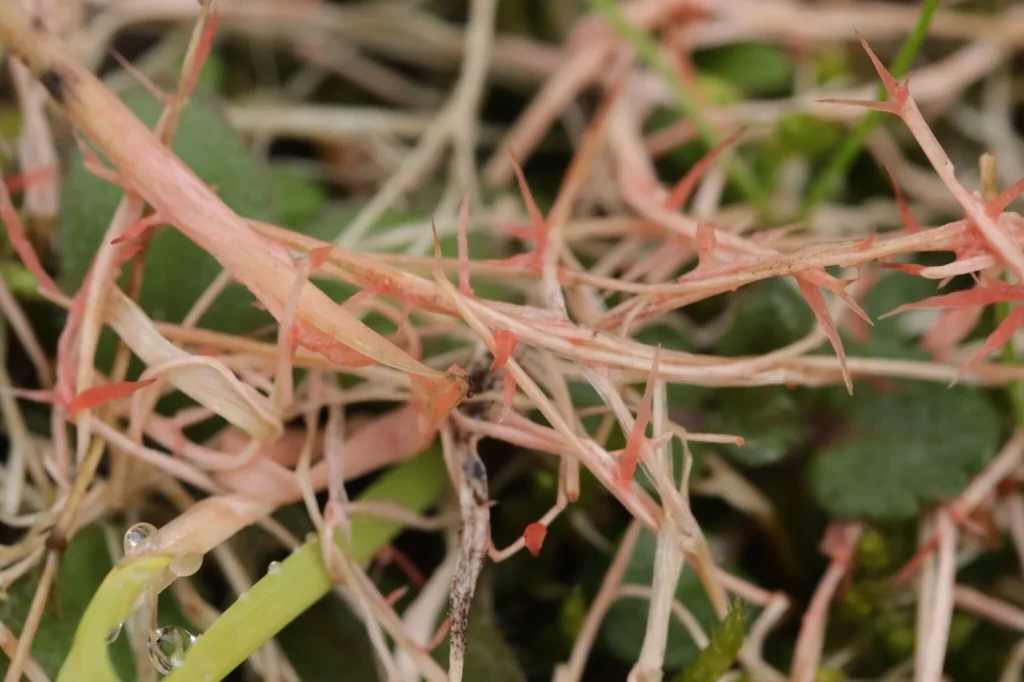
Red thread is a foliar disease caused by Laetisaria fuciformis. Its identifying sign is the one that sets it apart from every other common lawn disease: antler-like pink or red structures, called sclerotia, that grow out from infected blade tips. These are visible to the naked eye without a magnifying glass (Purdue Extension).
From a distance, affected areas look tan to pinkish-brown. Up close, the red or pink threads extending from the grass blades confirm the diagnosis. The disease is most active in cool (60-75°F), wet weather – typically spring and fall in most of the US – and thrives in lawns low in nitrogen.
Red thread does not kill the turf. Crowns and roots stay intact, so the lawn recovers once conditions improve. A nitrogen application often speeds that recovery.
Lawn Rust: Orange Dust on Shoes and Mower Decks
Lawn rust is caused by fungi in the genus Puccinia and is easy to confirm in a way no other disease offers: walk through your lawn and check your shoes and mower deck afterward. If they’re coated in orange or yellow-brown powder, you have rust (LawnStarter, 2025).
On individual blades, rust produces yellow or orange pustules that rupture and release spores. From a distance, the lawn looks yellowish-orange or pale. Rust is most common in late summer and early fall, especially during dry spells with heavy morning dew. It spreads on shoes, mower blades, and anything that passes through infected grass.
Rust typically affects lawns that are slow-growing due to low nitrogen, drought stress, or heavy shade. A balanced fertilization program and mowing on a regular schedule, which removes infected tissue, usually clears it up without fungicide.
Pythium Blight: Greasy Patches That Spread Overnight
Pythium blight is a fast-moving disease caused by Pythium species – technically water molds (oomycetes), not true fungi, which is why broad-spectrum fungicides often fail against it (LawnStarter, 2026). It looks like water-soaked, greasy patches of grass, dark and matted, that collapse and take on a rotten smell as they die.
In the early morning when humidity is high, infected areas may show cottony white or gray mycelium on the surface – sometimes described as looking like wisps of cotton candy. Damage can spread in streaks following water drainage patterns or mowing paths.
Per Michigan State University Extension, pythium blight is most destructive on cool-season grasses when temperatures run between 85°F and 95°F and evening temperatures stay at 68°F or above. Poor drainage, shaded areas, and overwatering set the stage for an outbreak. Systemic fungicides labeled specifically for Pythium must be applied within 24 to 72 hours of the first sign of infection to be effective (Oklahoma State University, via LawnStarter, 2026).
Bonus Signs That Confirm Fungus, Not Something Else
Two more signs are worth knowing because they are unmistakable once you’ve seen them.
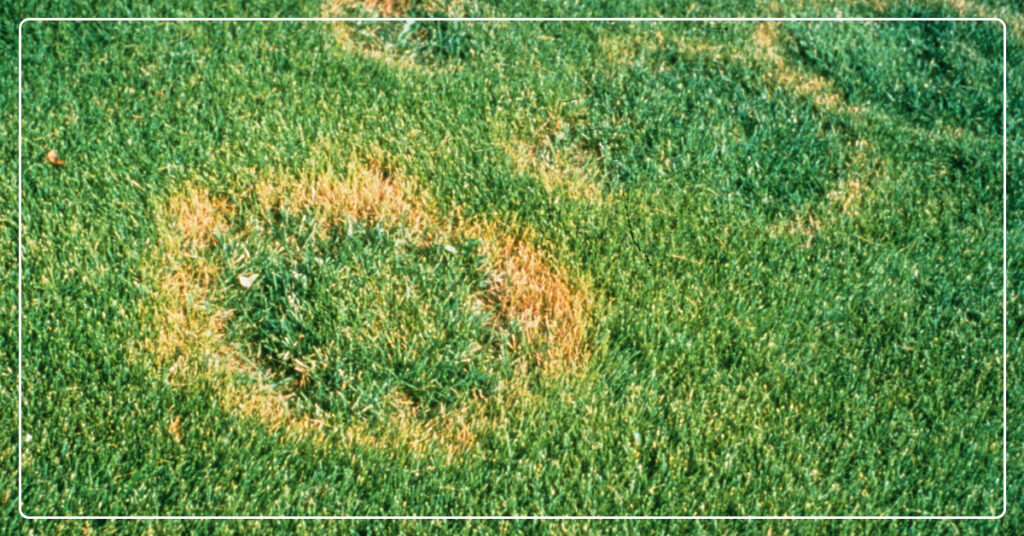
Fairy ring appears as a circle or arc of dark green grass, sometimes accompanied by a band of dead or thin turf, and often marked by mushrooms after rain. It is caused by more than 60 species of soil fungi that grow outward through the soil, decomposing organic matter and releasing nitrogen – which is why the grass at the ring’s edge often looks greener than everything around it (University of Missouri Extension). The soil inside the ring may feel dry or water-repellent even after watering.
Powdery mildew appears as a white or light gray powdery coating on the surface of grass blades – especially in shaded areas with poor air circulation. It’s common on Kentucky bluegrass and fine fescue in the late spring and early summer. Unlike rust, the powder doesn’t rub off as a colored stain. It looks exactly like someone dusted the grass with flour.
Lawn Fungus Disease at a Glance
| Disease | Visual Sign | Peak Season | Most Affected Grasses |
|---|---|---|---|
| Brown Patch | Circular tan patches; smoke ring in dew | July-August | Tall fescue, ryegrass |
| Dollar Spot | Silver-dollar patches; hourglass blade lesions | Summer | Kentucky bluegrass, bermuda |
| Red Thread | Pink/red threads on blade tips | Spring, fall | Ryegrass, fine fescue |
| Lawn Rust | Orange powder on blades, shoes, mower | Late summer, fall | Bluegrass, ryegrass, zoysia |
| Pythium Blight | Greasy dark patches; cottony mycelium | Hot, humid months | All cool-season grasses |
| Fairy Ring | Dark green circles; mushrooms after rain | Summer | All grass types |
| Powdery Mildew | White powder on blades | Late spring, shaded areas | Bluegrass, fine fescue |
Conditions That Cause Lawn Fungus to Spread
Lawn fungal spores are already in your soil – what triggers the disease is a combination of stress and moisture. Watering at night is the single most common contributing factor because it leaves grass wet for 8 to 10 hours without the sun to dry it off. Watering in the early morning allows the grass to dry out through the afternoon.
Other conditions that feed fungal diseases:
- Mowing wet grass (spreads spores via the mower deck across the entire lawn)
- Scalping the lawn below 3 inches for cool-season grasses, which stresses the turf
- Heavy nitrogen applications in hot weather, which accelerate brown patch specifically
- Compacted or poorly draining soil, which keeps moisture near the surface
- Thatch buildup over 0.5 inches, which holds humidity at the soil surface
The University of Florida IFAS turfgrass disease flowchart identifies soil drainage as a consistent factor across most patch-forming diseases, including large patch, take-all root rot, and fairy ring.
Common Mistakes Homeowners Make When They Spot Lawn Fungus
- Watering more when they see brown patches: Drought stress and fungal disease look similar from a distance. Watering more into a fungal outbreak almost always makes it worse. If footprints stay visible in the grass for several seconds, it’s drought. If the brown areas are circular and scattered, stop watering at night and confirm the diagnosis before adding more moisture.
- Applying the wrong fungicide: Pythium blight requires a product specifically labeled for Pythium. Broad-spectrum fungicides that work on brown patch or dollar spot will not work against Pythium because it is a water mold, not a true fungus. Using the wrong product delays treatment and wastes money.
- Mowing infected grass without cleaning the deck: A mower blade that cuts through a patch of red thread, rust, or brown patch carries spores to every other part of the lawn in the same pass. Rinse the mower deck with water after mowing infected areas.
- Skipping the cultural fix and going straight to fungicide: Fungicide controls an outbreak, but if the underlying condition – poor drainage, nighttime watering, thatch buildup – is not corrected, the disease returns the next season in the same spots.
Frequently Asked Questions
What are the first signs of lawn fungus?
The earliest signs are usually small discolored patches or spots on individual blades – yellow-green blotches, tan lesions with dark borders, or pale areas that look washed out. Brown or yellow patches that appear within a few days and have no uniform shape or clean edge are a reliable early indicator that fungus is active.
How do I tell the difference between lawn fungus and drought stress?
Drought stress turns grass bluish-gray first, then brown, and it affects large contiguous areas evenly. Footprints stay visible for several seconds in drought-stressed grass. Fungal damage appears as circular patches scattered randomly across the lawn, often with visible lesions on blades or fungal growth (threads, powder, or cottony material) in the early morning.
What time of year does lawn fungus appear?
It depends on the disease. Brown patch and pythium blight are summer diseases, most active when temperatures are above 80°F and humidity is high. Red thread and dollar spot peak in spring and fall during cool, wet weather. Rust is most common in late summer. Powdery mildew shows up in shaded areas during late spring.
Can lawn fungus spread to other parts of the yard?
Yes. Fungal spores spread through mowing equipment, foot traffic, water flow, and wind. Mowing over an infected patch and then continuing across the lawn is one of the fastest ways to spread rust, red thread, and brown patch. Pythium blight also spreads in streaks that follow water drainage patterns.
Does lawn fungus go away on its own?
Some do, with the right cultural corrections. Red thread and rust often resolve on their own once the weather changes and nitrogen levels improve. Brown patch and dollar spot may slow down as temperatures drop in fall. Pythium blight spreads too fast to wait out – it requires prompt fungicide treatment labeled for Pythium.
Should I call a lawn care company or handle lawn fungus myself?
For red thread, rust, and mild dollar spot, cultural corrections – adjusting the watering schedule, raising the mowing height, applying nitrogen – are usually enough. Brown patch and pythium blight in larger areas, or any disease that returns in the same spots year after year, are worth having a lawn care professional diagnose. A local university extension service (Penn State, Purdue, University of Minnesota) can also confirm a diagnosis from a sample for free or low cost.