When Does Grass Start Growing in Spring? It Is Not a Date
Grass does not start growing on a date. It starts growing at a soil temperature, and that temperature arrives weeks apart across the country. For cool-season lawns, Rutgers Center for Turfgrass Science states that growth "will become more vigorous once soil temperatures are consistently above 50 degrees F." Warm-season lawns wait considerably longer: University of Georgia turfgrass specialists tell homeowners not to feed until "the soil reaches 65 degrees." So the honest answer to when your grass starts growing is a number you can measure, not a month you can look up, and it differs by grass family, by region, and even by which corner of your own yard you are standing in.
That distinction is not a technicality. Almost everything people get wrong in early spring comes from acting on the calendar when the soil has not caught up.
The threshold, by grass family
There are two grass families and they wake on different schedules.
Cool-season grasses (Kentucky bluegrass, tall fescue, fine fescue, perennial ryegrass) resume real growth first. Rutgers puts the point where growth becomes vigorous at soil temperatures consistently above 50 degrees F. Note the word consistently. A single warm afternoon does not do it, because soil holds and loses heat slowly compared with air.
Warm-season grasses (bermudagrass, zoysiagrass, centipedegrass, St. Augustinegrass) stay dormant far longer, and the number attached to them is higher. The University of Georgia guidance for warm-season lawns is built around 65 degrees F soil temperature before the first feeding of the year. Rutgers, writing from New Jersey, notes that zoysiagrass in that climate is "not likely to exhibit substantial signs of growth (green-up) until late-May," while the cool-season lawns around it are already growing.
| Cool-season lawns | Warm-season lawns | |
|---|---|---|
| Common species | Kentucky bluegrass, tall fescue, fine fescue, perennial ryegrass | Bermudagrass, zoysiagrass, centipedegrass, St. Augustinegrass |
| The published threshold | Growth becomes vigorous once soil is consistently above 50 F (Rutgers) | UGA guidance is built on soil reaching 65 F before the first feeding |
| What shows first | Color returns while air is still cold; ryegrass ahead of tall fescue | Stays fully brown much longer; zoysia is the slowest of the group |
| The common mistake | Feeding and seeding weeks before the soil is ready | Reading normal late dormancy as winter kill |
If you are not certain which family is under your feet, the answer changes every date in your year, and the comparison of cool-season and warm-season grasses is the fastest way to settle it before you plan anything else.
Why "when does grass start growing in spring" has no national answer
Every page that answers this question with a month is making two assumptions it cannot support.
The first is geographic. The soil in a Georgia lawn crosses 65 degrees on a completely different week than soil in Michigan, and no national month covers both. This is the whole reason a spring lawn care calendar written for the entire country is close to useless.
The second assumption is smaller and stranger: it assumes your lawn has one soil temperature. It does not. Rutgers points out that "turf grown in shaded locations will remain cooler and hence be much slower to green-up than turf grown in full sun locations." A strip along a sunny south-facing wall can be genuinely growing while the shaded ground under a tree at the back is still cold and still brown. Homeowners routinely read that difference as a disease problem or a dead patch when it is a temperature map of their own yard.
Species differences stack on top of that. Rutgers observes that within cool-season lawns, "perennial ryegrass will be the earliest to green-up" and "tall fescue will be slower than perennial ryegrass," with Kentucky bluegrass varying by cultivar. A mixed-species lawn can green up in visible patches with nothing wrong with it at all, which is one reason a grass identification guide is worth running before you diagnose anything in early spring.
How to read the trigger without buying anything
You do not need to spend money to find out what your soil is doing.
Use a public soil temperature network. Several state weather networks run by land-grant universities publish live soil temperature and, importantly, state the depth. The Oklahoma Mesonet publishes 2-inch and 4-inch soil temperature maps updated every 15 minutes. For the Midwest, the Regional Mesonet Program hosted by the Midwestern Regional Climate Center produces soil temperature maps "at 2-inch and 4-inch depth for both bare soil and sod," updated daily, and they are reachable through the federal drought portal at drought.gov. Search for your own state's mesonet or extension weather network first, because a reading from your state is worth far more than a national average.
Watch your own lawn's warmest ground. The first area to green is normally the sunniest, most open, best-drained part of the yard. It is not proof of a temperature, but it tells you which direction things are moving, and it tells you which parts of the lawn will lag no matter what you do.
Treat plant indicators as a nudge, not a measurement. Forsythia bloom is the most repeated proxy in lawn care, and the extension services that study it are noticeably careful about it. The University of Maryland Extension Home and Garden Information Center calls forsythia bloom "rough, but not consistently reliable" as a guide for timing. Purdue University's turf program is blunter, noting that "forsythia will be in full bloom prior to crabgrass germination and forsythia flowers will wither near crabgrass germination," and that ornamental flowering is "not always a consistent predictor." Use it to start paying attention, not to make a decision.
If you buy one thing, buy the thermometer, and read the depth
A probe thermometer pushed into the ground is the direct route, and it settles the question in about a minute. But there is a rule that almost no consumer page states, and it matters more than the tool itself.
A soil temperature without a depth is not a number. Every credible threshold is published with a depth attached, because soil at one inch and soil at four inches can be several degrees apart on the same afternoon. Purdue's crabgrass germination figures are stated "at a one-inch depth." The Midwest mesonet maps are published at two inches and four inches, and separately for bare soil and for sod, because those read differently too. So when you take a reading, match the depth to whatever guidance you are acting on, take it in the same spot at the same time of day, and give the probe long enough to stop moving before you read it.
If a page gives you a soil temperature target and never says at what depth it was measured, that is a reasonable signal to go find a better page.
What acting on the calendar actually costs you
This is the part the month-based answers leave out. Acting early is not neutral. It has three specific, documented costs.
Fertilizer applied to cold soil. University of Georgia turfgrass specialists Clint Waltz and Gil W. Landry describe the mechanism plainly for warm-season lawns: fertilizing in late winter or early spring, before soils are warm enough to support continual growth, can accelerate green-up but cause detrimental long-term effects. The grass breaks dormancy on the nitrogen rather than on the season, and when a late cold snap arrives, the plant has already spent the stored reserves it needed to get through it. That is the opposite of a head start. It also explains a frustration a lot of homeowners describe every year, and the wider set of reasons behind it is covered in our guide to why fertilizer doesn't work sometimes.
Seed sown into cold soil. Seed does not germinate on a schedule either, and cool-season seed put down too early sits in cold ground where it is exposed to rot, birds and washout without doing anything useful. Nebraska Extension in Lancaster County, writing for that state, gives an ideal spring window of April 1 to May 15 and is direct that fall, roughly August 15 to September 15, is "actually the very best time of year for seed establishment with cool season turfgrasses." A spring seeding is the second-best option even when the timing is right. Doing it early makes it worse, and it is one of the more common reasons for a lawn that still looks thin after seeding.
The weed problem you create by guessing. Weeds run on their own thresholds, and they are not the same as your grass's threshold. Crabgrass is the clearest example, and it is also the clearest example of why a national number is a bad idea. The University of Maryland Extension states that crabgrass seed germinates "when the soil temperature is above 55°F for at least 3 consecutive days." Purdue University, citing published research, puts the start of germination at "57 to 64 °F at a one-inch depth," with large quantities not germinating until soil reaches "73 °F or above." Those are different numbers from two respected universities, and each is right for the conditions and the depth it describes. If your plan is to apply anything preventive, the timing decision belongs to your own state's Cooperative Extension service and to the label on the product in your hand, which is the legally binding instruction and overrides any general figure, including every figure on this page.
One conflict worth knowing before you plan a spring: Nebraska Extension warns that most preemergent herbicides will kill germinating grass seed, with mesotrione and siduron as the noted exceptions. Seeding and applying a standard crabgrass preventer are not two jobs you can fit into the same few weeks, so decide which one you want before the soil warms rather than after.
What to do in the weeks before the threshold
The honest answer is that the useful work in this window is preparation, not intervention. There is no product that makes cold soil warm.
- Clear winter debris. Rutgers advises removing "winter debris like branches, twigs, and leaves to avoid smothering damage during green-up." Low risk, and it genuinely helps.
- Stay off soggy ground. Walking and driving on saturated soil compacts it, and compaction is a problem you will still be paying for in July.
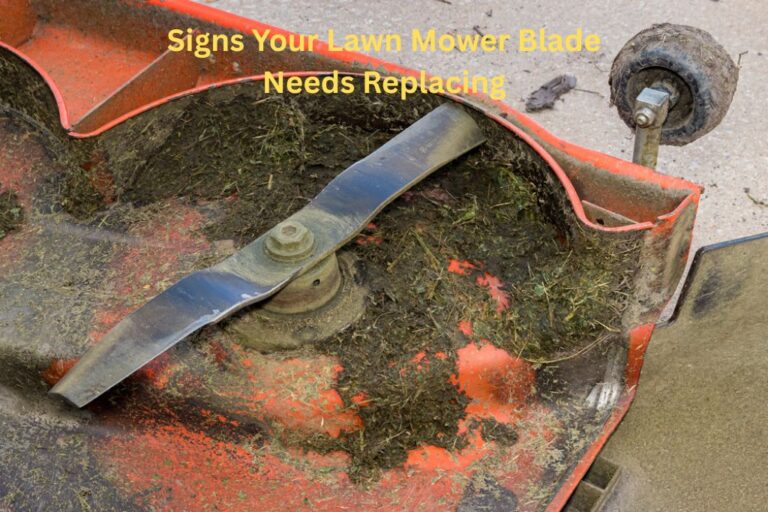
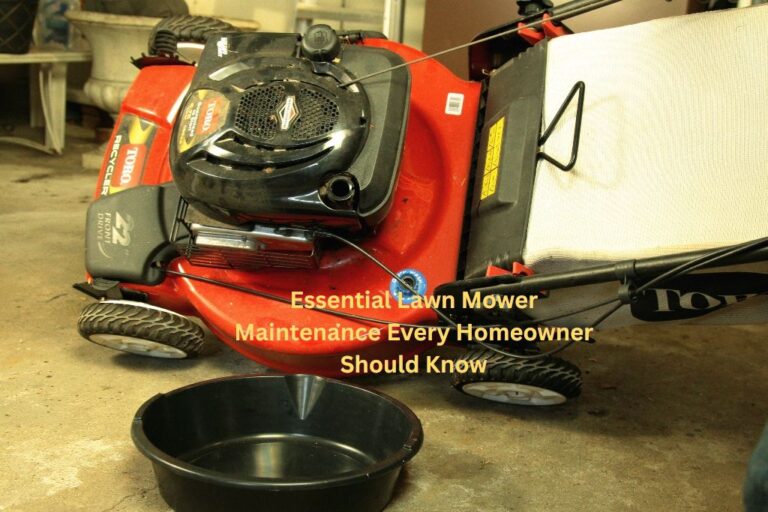
- Service the mower before you need it, not the morning you need it. Sharpening, an oil change and a blade inspection are all easier when the machine is not the only thing standing between you and an overgrown lawn.
- Get a soil test in. Extension soil test turnaround takes time, and a result that arrives before the growing season is worth far more than one that arrives in the middle of it.
- Do not scalp the first mow. On zoysia in particular, Waltz and Landry note the grass "will be set back anytime it's cut low enough that you can see the black mold under the leaf canopy."
- Resist raking hard on dormant turf. Vigorous raking on grass that has not started growing pulls out living crowns along with the dead material.
Green is not the same as growing
There is a gap between the first color change and the point where the lawn is actually producing new growth, and it matters because the two trigger different jobs. Color returning tells you the plant is waking. Sustained soil temperature above the threshold for your grass family is what tells you the plant can use nitrogen, recover from being cut, and knit into bare ground.
That gap is also why patience beats a product here. If your lawn is greening later than the one next door, the likely explanations are ordinary: more shade, different species in the mix, a different aspect, heavier or wetter soil, or simply a different cultivar. If slow green-up bothers you enough to change the lawn itself, that is a species decision rather than a timing one, and the lowest-maintenance grass options for your region is a better place to start than anything you could apply this month.
When brown is not just early
Slow green-up is normal. There is a point where it stops being normal, and the difference is pattern.
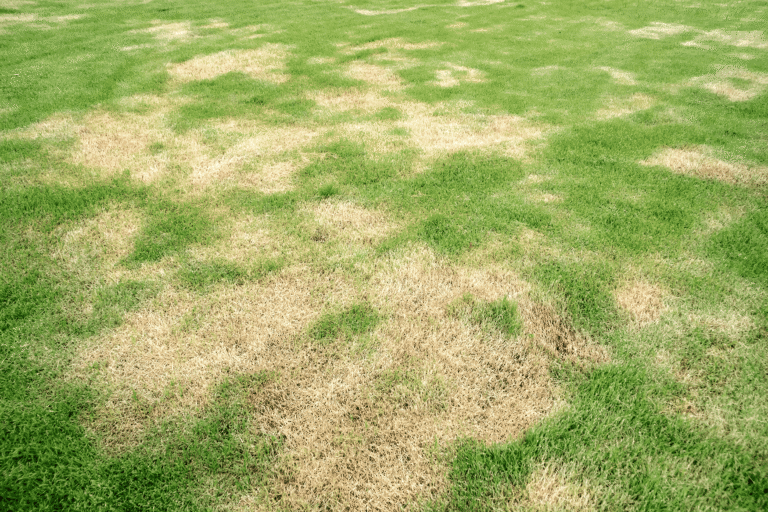
If the whole lawn is uniformly brown and coming back gradually, that reads as dormancy on a schedule. If one area stays brown while ground around it, in the same sun and on the same soil, has clearly moved on, that is worth investigating rather than waiting out. The University of Georgia list of causes for slow or patchy warm-season green-up includes thatch accumulation, scalping from mowing too low, large patch disease caused by Rhizoctonia, and microclimate variation within the same yard. Several of those look identical from a standing position and different from a kneeling one. Our guide to grass that looks burnt without heat covers the localized causes worth ruling out before you assume your lawn is just late.
The page to bookmark instead of this one
Every number above is a national generalization, and the correct number for your yard depends on your state, your grass, and in some cases your specific cultivar. Your state's Cooperative Extension service publishes turf guidance written for your climate, often down to the county, and it is free. A search for your state name plus "cooperative extension turfgrass" normally reaches it in one click, and the USDA National Institute of Food and Agriculture maintains a directory of every state's extension service.
That is not a hedge. It is the actual answer. A national date for a regional event is worse than no date at all, because it gives you the confidence to act on the wrong week.
FAQ
What soil temperature does grass start growing at?
It depends on the family. Rutgers Center for Turfgrass Science states that cool-season grass growth becomes more vigorous once soil temperatures are consistently above 50 degrees F. For warm-season lawns, University of Georgia guidance is built around soil reaching 65 degrees F before the first feeding of the year. Both figures assume a sustained reading, not a single warm day.
Why is my neighbor's lawn green before mine?
The most common reasons are shade, species mix and aspect. Rutgers notes that shaded turf stays cooler and greens up much more slowly than turf in full sun, and that perennial ryegrass greens up earlier than tall fescue, with Kentucky bluegrass varying by cultivar. Two lawns on the same street can be weeks apart with nothing wrong with either.
How deep should I measure soil temperature?
Match the depth to the guidance you are acting on, because guidance is always published with a depth attached. Purdue's crabgrass germination figures are stated at a one-inch depth. The Midwestern Regional Climate Center publishes soil temperature maps at both 2-inch and 4-inch depths, and separately for bare soil and sod, because those surfaces read differently.
Can I make my grass green up faster?
Not safely by feeding it early. University of Georgia specialists describe fertilizing before soils are warm enough as something that can accelerate green-up while causing detrimental long-term effects, because the plant breaks dormancy on stored reserves it then needs when a late cold snap arrives. Clearing debris, keeping off wet soil and not scalping the first mow are the useful levers.
Is it too early to seed?
For cool-season lawns, spring seeding works but it is not the best window. Nebraska Extension in Lancaster County describes fall, roughly August 15 to September 15, as the very best time of year for cool-season seed establishment, and gives April 1 to May 15 as the spring window for that state. Check your own state's extension for local dates, and remember that most preemergent herbicides will kill germinating grass seed.
Does forsythia blooming mean my grass is growing?
No. Forsythia is a rough phenological indicator, and the extension services that study it are careful about it. The University of Maryland Extension calls it "rough, but not consistently reliable," and Purdue notes that forsythia is typically in full bloom before crabgrass germination and that ornamental flowering is not always a consistent predictor. Treat it as a prompt to start measuring, not as the measurement.
Sources
- Rutgers Center for Turfgrass Science, "Spring Green-up" (turf.rutgers.edu)
- Clint Waltz and Gil W. Landry, University of Georgia College of Agricultural and Environmental Sciences, "Help warm-season turfgrasses green-up" and "Spring green-up problems in warm-season turf grass" (fieldreport.caes.uga.edu)
- University of Maryland Extension Home and Garden Information Center, "Crabgrass" (extension.umd.edu)
- Purdue University, Purdue Turf Tips, "When Will Crabgrass Germinate?" (purdueturftips.blogspot.com)
- Sarah Browning, Nebraska Extension in Lancaster County, "Spring Lawn Overseeding" (lancaster.unl.edu)
- Oklahoma Mesonet, 2-inch and 4-inch soil temperature products (mesonet.org)
- Midwestern Regional Climate Center, Regional Mesonet Program soil temperature maps, via drought.gov
Anything applied to a lawn is governed by the label on that product, which is the legally binding instruction. Where this page and a label disagree, the label wins.